Microsoft Fabric Implementation Partner
Whether you are evaluating Fabric, modernizing legacy systems, or scaling an existing Fabric implementation, ProArch can help you move forward with clarity, speed, and governance.
challenges
Your Data Is Growing. So Is the Complexity Around It.
Your data may live across different systems, clouds, and reporting tools. Without a connected, governed data foundation, teams spend more time finding, preparing, and validating information than using it to make decisions.
Without the right foundation:
- Teams spend more time preparing data than using it
- Reports and insights are delayed, inconsistent, or unreliable
- Analytics and AI initiatives struggle scale

Unify Data. Enable AI.Move Faster.
Microsoft Fabric gives you unified data platform with AI-powered features to bring your data together, simplify access, and empower every role with the AI insights they need.
As a Microsoft Fabric Featured Partner, ProArch brings the expertise to support your Fabric journey.
Our Microsoft Fabric consultants guide you from assessment to optimization, with security, governance, and performance best practices included from day one.
SIGNS YOU’RE READY FOR FABRIC
Where ProArch Can Help You in Your Fabric Journey
When these initiatives and roadblocks start coming up, ProArch’s Microsoft Fabric consulting services can turn them into a clear Fabric strategy, architecture, and implementation plan.
- We want to use AI, but our data foundation is not ready
- Our data is spread across too many systems
- Should we choose a lakehouse or a warehouse in Fabric
- We are implementing Fabric and need a second opinion
- We want to expand our Power BI reports beyond data visualization
- We want real-time insights, but our reporting is slow and manual
- We need stronger governance as data access expands
FABRIC CAPABILITIES & SOLUTIONS
ProArch Microsoft Fabric Services
As a Microsoft Fabric implementation partner, ProArch provides Microsoft Fabric consulting, implementation, and on-going optimization that puts in place a connected data strategy to help you stay ahead of whatever comes next.
Fabric 6-8 Week ImpactNOW Assessment
ProArch’s Fabric ImpactNOW Assessment is a 6-8 week proof-of-value engagement to determine whether Fabric delivers measurable business outcomes before full investment.
- Data estate and reporting landscape evaluation
- A functional use case running in Fabric
- Measurable business outcomes tied to KPIs
- Clear “go / no-go / scale” recommendation
- Roadmap for broader Fabric adoption
Fabric Architecture Review
ProArch helps you review your current Fabric implementation to identify design gaps, risks, performance issues, and cost concerns, then define a clear roadmap.
- Review OneLake, lakehouse, and warehouse design
- Assess pipelines, semantic models, and data flows
- Identify performance, cost, and design issues
- Governance and security gap analysis
- Prioritized remediation roadmap
- Get your data in Fabric AI Ready
Fabric Migration & Modernization
We modernize your existing platforms—whether Power BI, data warehouses, or fragmented reporting environments—into Fabric for faster, more reliable reporting.
Power BI to Fabric Modernization
- Consolidate duplicate datasets
- Implement governed semantic models
- Improve report performance and consistency
- Enable scalable self-service analytics
Data Warehouse Migration
- Assess legacy warehouse architecture
- Plan and execute migration to Fabric
- Modernize reporting and analytics workflows
Fabric Implementation & Data Modernization
Our Microsoft Fabric implementation services put in place a connected data platform in Fabric that becomes your single source of truth.
- Design and implement your core OneLake architecture
- Integrate data across systems and clouds into a unified platform
- Build a robust lakehouse and warehouse models
- Standardize data models and semantic layers
Real-Time Analytics & Advanced Workloads
We implement real-time intelligence (RTI) capabilities in Fabric to help you respond to events as they happen.
- Set up streaming data ingestion and pipelines
- Configure real-time processing and analytics
- Implement anomaly detection and alerts
- Build live dashboards and event-driven workflows
Fabric Managed Services
ProArch helps you operate, govern, and continuously improve your Fabric environment after deployment.
- Review architecture, pipelines, and models
- Optimize performance and Fabric capacity utilization
- Provide ongoing support and enhancements
- Setup monitoring for all Fabric workloads
- Data Quality monitoring
- Evergreening (keep runtime, components up to date)
FABRIC CASE STUDY
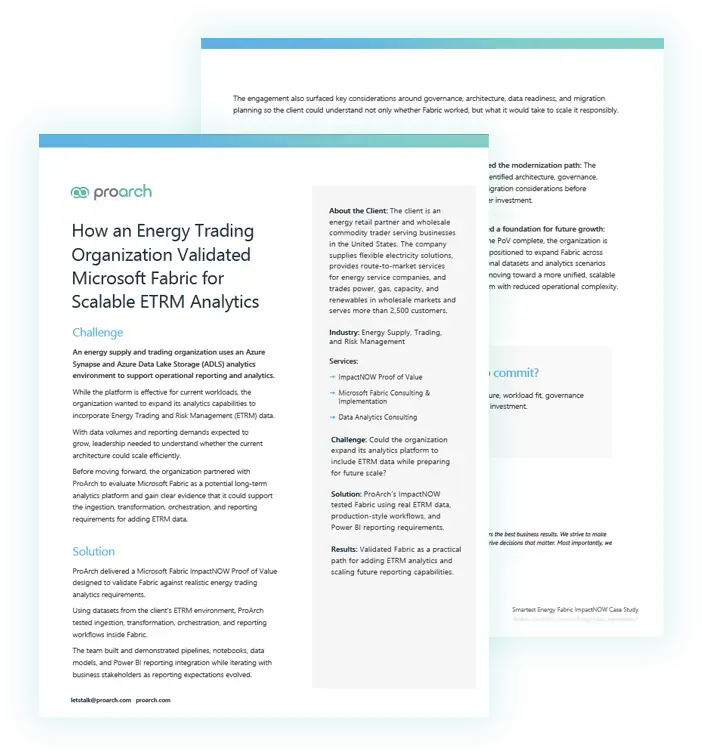
Why an Energy Trading Firm Chose Fabric for Advanced Analytics
Using ImpactNOW, the company validated Microsoft Fabric for evolving analytics requirements, giving leadership an evidence-backed roadmap to scale with confidence.
Why proarch
Microsoft Fabric Implementation Partner for Data, AI, and Scale
- Proven ImpactNOW framework to validate value before scaling
- End-to-end delivery from assessment → implementation → optimization
- Deep expertise across Fabric, Power BI, Purview, and AI workloads
- We focus on business outcomes, not just platform deployment

OUR MICROSOFT FABRIC CONSULTANTS
Meet ProArch’s Fabric Experts
Lakshman Kaveti
Managing Director of Data, AI and App Dev

Phani Vanka
SVP of Technology

Venkatesh Rajupalepu
VP of Digital Engineering

Build a Data Platform That Actually Delivers Outcomes
Start with proof. Scale with confidence.
Frequently Asked Questions
How do we know if Microsoft Fabric is the right fit for our organization?
Microsoft Fabric is usually a good fit when:
- Your data is spread across multiple systems
- Your reporting is slow or inconsistent
- Your governance is getting harder to manage
- Your AI initiatives need a trusted data foundation
Whether Microsoft Fabric is the right fit also depends on your existing Power BI and Azure investments, data, analytics, and future AI initiatives.
Organizations can determine whether Microsoft Fabric fits their data needs by testing it against real data needs through ProArch Fabric ImpactNOW.
How does Microsoft Fabric prepare our data for AI and AI agents?
Microsoft Fabric is an analytics platform that brings all your data and analysis tools into a single environment.
Organizations can use Fabric for creating data pipelines or unifying data to build AI and agents on top of it.
What is the best first use case for Microsoft Fabric?
The best first use case addresses a clear reporting, analytics, or data challenge and can deliver measurable business value.
Common starting points include
- Executive dashboards
- Finance or marketing reporting
- Sales analytics
- Operational reporting
- Customer analytics, and
- Supply chain visibility
- Organizing data to build agents
ProArch helps evaluate your data, business priorities, technical dependencies, and expected outcomes to select a focused use case. This allows you to validate Microsoft Fabric’s value before expanding to additional workloads.
Can we migrate from Azure Synapse to Microsoft Fabric and keep our existing Power BI reports?
Yes, you can migrate from Azure Synapse to Microsoft Fabric while retaining your existing Power BI reports. Fabric brings data engineering and analytics into a more unified environment, reducing the need to manage separate Azure services.
ProArch assesses your Synapse workloads, maps them to Fabric, migrates schemas and pipelines, and reconnects your Power BI semantic models to the new data sources. We validate the migrated data against your existing environment before production cutover to minimize disruption to reporting.
Should we use a lakehouse or a warehouse in Microsoft Fabric?
The right choice depends on your workloads and your team’s skills.
A Fabric lakehouse is well suited to structured and unstructured data and Spark-based data engineering.
A Fabric warehouse is a good fit for SQL-focused teams and structured reporting.
Many organizations use both on OneLake.
ProArch helps you choose the right approach during architecture design or review, based on your data, reporting needs, and team capabilities.
Do you build Fabric lakehouses with a medallion (Bronze, Silver, Gold) architecture?
Yes. Bronze keeps source data as it arrived, Silver cleans and conforms it, and Gold holds the business-ready tables and semantic models that Power BI reports and AI agents use.
Many organizations start with a structured pilot that builds a working medallion lakehouse for one use case before scaling.
Can ProArch help with Microsoft Fabric data governance and security?
Yes. ProArch designs governance into Fabric, covering workspace and access design, role-based and row-level security, data ownership, classification and lineage.
For deeper governance, ProArch integrates Microsoft Fabric with Purview for data cataloging, business glossaries, lineage and sensitivity labeling. This often starts with a focused pilot on priority data before scaling across the estate.
Can ProArch support enterprise-scale Fabric and large data engineering teams?
Yes. As a Microsoft Fabric Featured Partner, ProArch brings experience delivering customer solutions on Fabric—giving you a partner with practical implementation expertise to support enterprise-scale adoption.
We help large data engineering teams build and collaborate consistently through:
- Separate development, test, and production environments
- Git integration and CI/CD deployment pipelines
- Workspace standards and clear ownership
- Reusable data pipelines and shared semantic models
This foundation helps teams release changes consistently, reuse trusted data, and reduce duplicate datasets as adoption grows.
Can ProArch guide us on Microsoft Fabric licensing, capacity and cost?
Yes. ProArch sizes Fabric capacity based on your workload mix, user concurrency, refresh patterns, and data engineering and real-time workloads.
We recommend the right F SKU and compare pay-as-you-go with reserved capacity.
For existing environments, we analyze capacity usage, optimize pipelines, notebooks and semantic models, and set up monitoring so costs stay predictable.
How long does a Microsoft Fabric implementation take?
The timeline for a Microsoft Fabric implementation depends on your use case, data sources, migration scope, and security and governance requirements. A large-scale implementation, migration, or modernization that moves your remaining reports and workloads onto Fabric typically takes 3–6 months.
If you want to evaluate Fabric before committing to a larger investment and rollout, ProArch Fabric ImpactNOW helps you assess its fit for your business in 6–8 weeks.
Who manages Microsoft Fabric after implementation?
Your internal data, analytics, and Power BI teams can manage Microsoft Fabric with training and knowledge transfer from ProArch. We help define the operating model and document best practices so your team can manage the platform confidently.
For ongoing support, ProArch offers Fabric optimization and managed services that may include:
- Performance tuning and platform optimization
- Governance support
- Cost monitoring
- User training and enablement
- Roadmap planning and expansion
ProArch can also take over management of your existing Fabric environment, helping resolve issues, improve performance, optimize costs, and support new use cases as your business needs evolve.