
Most teams struggle with siloed data and slow insights. Microsoft Fabric is designed to close this gap by bringing ingestion, governance, analytics, and AI-readiness together in a single, unified platform.
TL;DR
Here’s the quick breakdown of what you need to know about Microsoft Fabric
What is Microsoft Fabric?
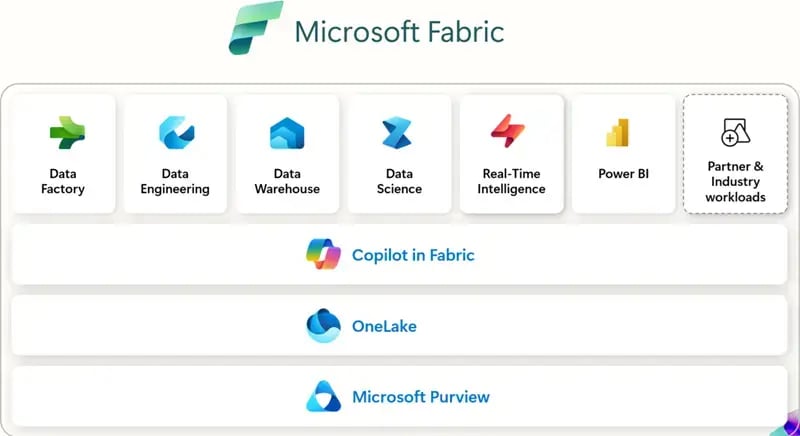
Microsoft Fabric is an analytics platform that brings all your data and analysis tools into a single experience.
Fabric moves away from individualized services to a unified stack with everything an organization needs for their analytics workloads- including generative AI built it.
So, whether you are creating data pipelines or building AI solutions, you can use a single platform to:
- Unify your data estate
- Build powerful AI agents and models
- Responsibly put insights in the hands of everyone
Key Features of Microsoft Fabric
Unified Data Foundation Enterprises Actually Need
Every enterprise wants one thing: a single, governed data foundation where data from every system comes together securely and is ready for analytics, real-time insights, and AI.
But most organizations are facing fragmented pipelines, duplicated data, inconsistent governance, and inconsistent analytics.
Microsoft Fabric stands apart because it is designed specifically to close these gaps. It brings ingestion, governance, analytics, and AI-readiness together in one platform—so organizations can stop stitching systems together and start operating from a shared, trusted data foundation.
OneLake Turns Data into a Shared Enterprise Asset
At the core of Fabric is OneLake, a centralized, unified data lake that acts as the single source of truth. Unlike traditional architectures where teams copy data into multiple systems just to use it, OneLake stores data once and securely shared across engineering, analytics, and BI workloads.
This eliminates duplication, reduces operational complexity, and ensures every team works from the same source of truth.
And with Microsoft Purview natively integrated in Fabric to provide classification, lineage, access control, and compliance policies, the result is data that is discoverable, reusable, and trusted.
Unify, Govern, and Accelerate Data Insights Across Your Organization
Security and Governance Are Built In
Microsoft Fabric is designed for enterprises where security, compliance, and auditability are essential. Instead of bolting governance on later, Fabric incorporates security controls and policies at the core:
Built for Analytics, Real-Time Insights, and AI on the Same Data
Fabric supports a full spectrum of workloads on the same governed data foundation:
- Batch analytics and data warehousing
- Real-time streaming and insights
- AI and machine learning workloads
By enabling streaming ingestion and real-time analytics directly on OneLake’s unified store, teams can generate timely insights without separate systems or duplication.
Fabric also embeds AI capabilities throughout the platform — lowering barriers to insights and accelerating time-to-value. Copilot and AI-assisted workflows help both technical and business users interact with data more productively.
For organizations with specialized data engineering or advanced AI needs, Fabric is designed to coexist with tools like Databricks, allowing enterprises to choose the best tool for each workload while maintaining governance and collaboration across the stack.
Designed Around How Data Teams Actually Operate
Rather than forcing teams into separate tools with separate security models, Fabric provides role-based experiences within a single platform. Data engineers, analysts, data scientists, and business users all work against the same governed data—using tools suited to their roles.
How Microsoft Fabric Fits with Azure Analytics
For organizations already using Azure analytics services, it’s important to understand how Fabric fits in. Microsoft Fabric is not a replacement for Azure Synapse Analytics. Synapse remains fully supported and continues to serve scenarios that require deeper infrastructure control or hybrid deployments.
However, Fabric represents the next step towards a unified analytics platform that simplifies adoption of governance, real-time processing, and AI for a broad set of enterprise workloads within the Microsoft ecosystem.
Microsoft Fabric Implementation Steps
ProArch helps organizations validate Microsoft Fabric in just six weeks by standing up a scalable pilot, integrating priority data sources, and delivering quick-win dashboards that prove value before an enterprise rollout.
Step 1: Exploration & Strategy
We align Microsoft Fabric with your business goals by assessing the current data landscape, identifying gaps, and defining a clear adoption roadmap. This step focuses on setting direction early and securing executive buy-in before implementation begins.
Step 2: Fabric Use Case
Rather than deploying Fabric broadly, ProArch anchors the implementation around a specific, high-impact business use case. We integrate priority data sources into OneLake, establish a governed lakehouse structure, and deliver quick-win dashboards that demonstrate unified data access and faster insights—while defining a path to scale.
See Fabric Use Case in Action: Validating Microsoft Fabric for Energy Trading Analytics
An energy supply and trading organization partnered with ProArch to evaluate whether Microsoft Fabric could support expanding ETRM analytics requirements.
Through a Microsoft Fabric ImpactNOW Proof of Value, ProArch tested real ETRM data across ingestion, transformation, orchestration, data modeling, and Power BI reporting workflows helping leadership validate Fabric’s feasibility, understand governance and migration considerations, and build confidence before broader investment.
Step 3: Modernization & Migration
Legacy reporting and analytics workloads are moved into Microsoft Fabric. OneLake is implemented for unified storage, pipelines are optimized for performance and reliability, and secure, compliant access is enabled across teams.
Step 4: Enterprise Scale & Innovation
Once value is proven, ProArch scales Fabric across more workloads to support advanced analytics, real-time scenarios, and AI/ML workloads. Governance is formalized, and ongoing optimization ensures performance, cost control, and long-term adoption.
How to Build Agents that Understand Your Data with Copilot Studio and Microsoft Fabric
Solving Data Fragmentation with Microsoft Fabric
A Use Case by ProArch
A global coatings manufacturer was struggling with fragmented data spread across SAP, Salesforce, Workday, proprietary applications, and third-party data sources.
Manual extraction and spreadsheet-driven reporting created inconsistencies and slowed decision-making. Additionally, the absence of Change Data Capture (CDC) meant full data loads from SAP were required, straining system performance and delaying analytics.
To address this, ProArch proposed a proof of concept using Microsoft Fabric and OneLake to centralize structured and unstructured data into a unified lakehouse architecture.
The solution follows a medallion model
- Bronze layer: Raw data ingested from SAP, Salesforce, Workday, proprietary systems, and external sources into OneLake
- Silver layer: Data cleaned, standardized, and aligned to a canonical schema
- Gold layer: Business-ready data optimized for reporting and analytics
Within six weeks, ProArch:
- Deployed the Microsoft Fabric environment
- Implemented CDC pipelines to eliminate full data reloads
- Built a canonical data model
- Delivered a pilot dashboard with actionable, cross-system insights
Result: A unified data foundation that delivers faster insights and a scalable, AI-ready foundation for the future.
Simplify Data Ecosystem with Microsoft Fabric
As a Microsoft Fabric Featured Partner, ProArch is among a select group recognized by Microsoft for proven expertise in designing, implementing, and scaling Microsoft Fabric solutions.
That means when you work with us, you get:
- Confidence in delivery, backed by Microsoft recognition
- Specialists who have built Fabric led solutions from the ground up
- A Microsoft partner who helps you turn your data into actionable decisions
Looking to do more with your Microsoft investment? Talk to ProArch, a top Microsoft Solutions Partner.